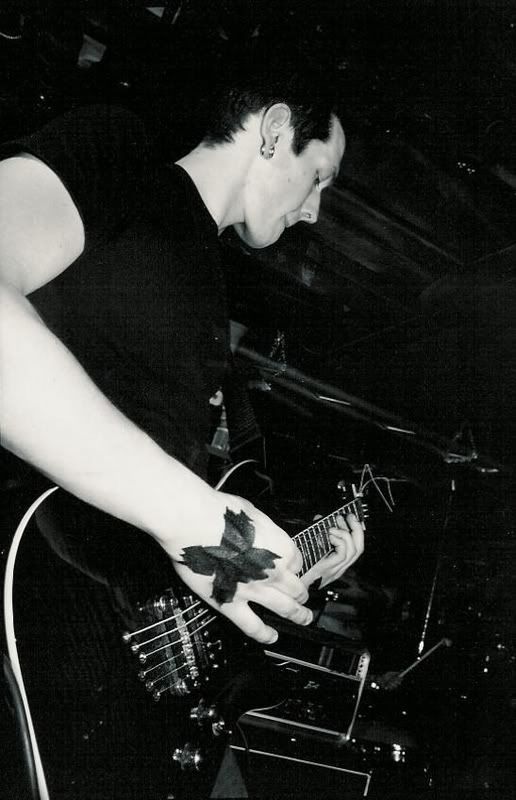
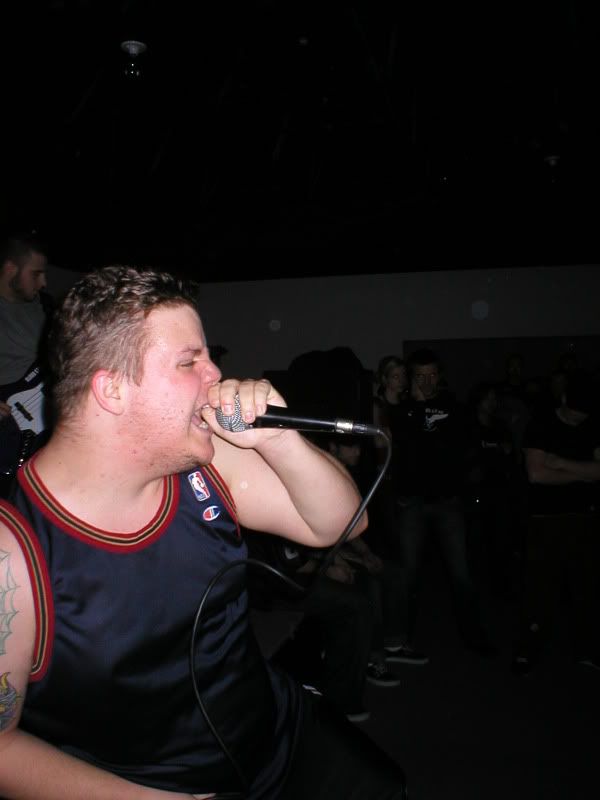
That statement sums up the short-lived, yet prolific career of Moshalicious.
Made up of a virtual all-star Salt Lake City line-up, the group was comprised of former and current members of Opened Up, Cherem, Aftermath of a Trainwreck, Sleeping Giant and Tamerlane. The goal of the band was simple: live up to the name.
And live up to the name they did. Taking inspiration from the band Bad Luck 13, the group got together one evening in the early fall of 2001 to write one epic song that would move crowds from front to back and side to side. They wanted all hell to break loose.
The only show the band ever played was at a small coffee shop called Undergroundz. It was a surprise set that everyone knew would come eventually. There had been too much talk and too many rumors swirling that everyone that regularly attended a hardcore show that summer knew it was bound to happen sooner or later.
The show carried along fine, until a drifter appeared in front of the coffee shop eager to tell tales and bask in the attention usually only reserved for sideshow freaks. The vagrant produced a dildo and bottle of toothpaste and proceeded to brush his teeth on the sidewalk for all to see. He then stormed inside and preformed a one man show that would later be referred to as "The Undercover Cop." Every eye was fixated as he waved his hands in the air and moved about the room and yelled for all to hear. When he was finished, he took a bow, yet no one clapped. The crowd was too stunned and unsure of what they had just witnessed.
But it was nothing compared to what they were about to see.
In the back of the coffee shop, Compilate had graciously (but foolishly) allowed the members of Moshalicious to borrow their equipment—because a sneak attack cannot be done properly if the band is forced to bring their own—and the stage was set.
The seven men, all donning masks and hooded sweatshirts launched into their first, last and only song, "Friends Don't Let Friends Fight Alone" and unleashed the fury.
Very few lyrics were actually audible as the three vocalists stormed the room, dancing with bats and dodged pieces of cinder block flying through the air. One bat became tangled in guitar chords and during a rather impressive spin-move, a vintage effects pedal was hurled through the audience, connecting with and breaking the thumb of the very man that had been kind enough to loan it out. As that happened, the guitarist became enraged and took to the dance floor himself, swinging the guitar above his head, daring anyone to get in the way.
As the majority of the crowd stood in stunned silence towards the end of the song, the vagrant burst into the room igniting a whole new level of energy. He too, joined the madness and began flinging bricks and inflicting harm upon himself by smashing his own skull with a miniature bat.
When the song ended, not a single person clapped. The silence was deafening and no one was quite sure what had just happened, but they all knew they had witnessed something special.
Sadly, the only video footage of the show was destroyed and Moshalicious was never seen again, yet the legend lives on.
Better Way, with the help of close-friends Insight, drafted the Utah chapter of the Youth Crew history book. During the late '80s, the band churned out sing-along inspiring anthems, while sharing the stages of The Word and The Speedway with the likes of Insted, Slapshot and Gorilla Biscuits.
A Path to Take, the band's 1989 self-released demo, boasts strong influence from the New York Hardcore scene and some of the greatest lyrics on overcoming personal hardship this side of Break Down the Walls. (Makes sense that Ray and Porcell are mentioned in the record's thank you list.)
One thing that set A Path to Take apart from the Youth Crew crowd was its brief forays into groovy, guitar experimentation (See: The last 30 seconds of "The Fight.") These hints of technicality came to make perfect sense as guitarist Gentry Densley went on to guide Iceburn through 15 years of sonic exploration. The band threw in the towel shortly after the release of A Path to Take.
Better Way's vocalist Dustin worked at Raunch back in the day and ran his own short-lived shop on 21st South called "Rock City." Gentry Densley continues to push the limits of heavy music with Eagle Twin and Ascend. Guitarist Randy also played with local rock band Dinosaur Bones. Various members also played in fellow late-80s Salt Lake straightedge band Head Strong (if you know which ones, fill us in!).
In Fall of 1995, Alex Slack, Taylor Williams, Dustin Black and Zach Clough got together in Williams’ parents' basement to start a new band that was darker and heavier than anything Salt Lake had ever seen. Williams and Black each brought half a song—which would, by the end of the night, become “Darkness” and “No Time” respectively—and one of Salt Lake’s most revered bands—Lifeless—was born.
In 1996, Lifeless unleashed their new sound on Salt Lake City in the basement of the now-burned-down Club DV8. “It was an awesome show. Alex and Dustin were pretty prominent members of the local hardcore scene and Pathway (Williams and Clough’s previous band) had gained a decent following as well, so I remember it being pretty packed,” said Williams. “I think we only had like 4 songs and I wasn’t sure what people were going to think of it because it was pretty aggressive and different from other SLC shit at the time. All of our songs were about death, suicide and self-loathing.”
To their surprise, people loved it. The band built a solid following and were soon turning heads with their new, darker approach to hardcore. The Salt Lake scene had been dominated by the likes of Insight, Iceburn and the Flatline Records roster during the early 90s--either traditionally-rooted or bizzarely-experimental. But with the rise of Lifeless, and metallic compatriots Clear, Climb and Triphammer, the modern Salt Lake Hardcore sound was born.
Later that year, Excessive Force came to town for a show at the New Hope Center in North Salt Lake. Lifeless was on the bill and another Salt Lake band that had just formed, XClearX, was set to open. XClearX took the stage for the first time and when their set was over, Dan Gump approached a the band and told them he wanted to put out their record on his label Life Sentence Records.
“Everyone in Lifeless was flabbergasted,” said Williams. “It was [XClearX's] first show and someone already wanted to put out their record? We were a little jealous and a little mad, but said ‘fuck it’ and went up and shredded our little hearts out.” This frustration paid off.
“We got done with our set and Dan approached us saying he wanted to put out a record with us as well," said Williams, "We were stoked." Later that year XClearX's The Sickness Must End and Lifeless' self-titled 7" were released on Life Sentence.
The record made a big splash but was the band's only release. Two more songs, “Stomp A Mudhole In Your Ass” (an homage to the band Bowel) and “Opened Up” (the inspiration for the early 2000s band), were recorded but were never put out in any official capacity.
“We had a period of intense writing where we didn’t play any shows and wrote about 6 or 7 new songs that were a huge step forward,” said Williams. “We were going to debut our new material with Madball at an old venue called Spanky’s, but there was a full-scale riot during the show and we didn’t get to play.”
The band eventually did get the chance to debut their new songs when they opened for Vision of Disorder. Sadly, that would end up being their last show. Slack was a huge hockey fan and shortly after that show, he and his girlfriend took a trip to Denver to see a Colorado Avalanche game. As the two were driving back to Salt Lake, they hit a patch of black ice on that dangerous stretch of I-80 that has plagued nearly every band trying to make it through and the car rolled into a ditch. Slack severed part of his spinal cord and was paralyzed from the neck down.
Without Alex’s presence—a vital part of Lifeless’ energetic live shows—and his attitude, the band was through. Bands replace singers all the time, but Alex was different. He was such an integral part of Lifeless that it seemed silly to even entertain the notion of carrying on without him. Initially, there was talk of having James Hart (singer of Eighteen Visions and a good friend of Slack's) take over, but in the end it just wouldn’t have been the same.
“Alex just had this energy and brutality to his singing and his performance that just couldn’t be replaced,” said Williams. “It sounds kind of hokey, but he really did have an aura about him. He was a really magnetic sort of person. He was the type of person that people wanted to be around and listen to.”
On June 29, 1999, more than a year after his accident, Alex Slack committed suicide.
Dustin Black tried a few times to get a new version of Lifeless together after his death, but none of them made it past the practice stages. “I didn’t really want anything to do with it anymore,” said Williams. “It ended up being this huge black hole of negative feelings for me, mostly associated with Alex’s death. Without Al there was and is no Lifeless for me.”
It’s been over a decade since the last time Lifeless played live, but the band’s legacy is still very alive in Salt Lake City. “No Time,” “Darkness” and “Zero” have been covered by numerous bands and getting your hands on a copy of everything the band recorded is something of a right of passage in the Salt Lake hardcore scene.
“I think it is pretty fucking sweet that people in SLC still have love for Lifeless,” said Williams. “Jesus, it was 14 years ago when we formed and kids are still into it! That blows my mind!
Williams may have grown as a musician and a songwriter, moving onto more experimental acts Glacial and Black Sleep of Kali, but he’s still got a soft spot for those early, stripped down Lifeless recordings.
“It is kind of funny because when I listen to those early songs they are really simple and kind of crude, but they still work. The recording is so shitty, but I think it helped showcase how raw it was. We set out to create something that hadn’t been done before. We were after a brutal sound and wanted that to come across in the lyrics, the music and the artwork. I think we accomplished that.”
Lifeless performing at the Life Sentence Records Showcase:
SDB's longest running line-up. Circa 2004. Jake, Blake, Dan, Robbie, Little E
On a cold Fall evening in 2003, Blake Foard, Dan Fletcher and Eddie Golub sat around a table at the infamous Salt Lake Coffee Break. The subject of discussion? A new Salt Lake Hardcore band. Coming from Aftermath of a Trainwreck, Cherem and Tamerlane respectively, the trio sought to break from the more metallic sound of their other outfits and create something more aligned with the late 80s sounds of Slapshot and Judge. One or two practices later, the project dissolved.
Some months after that, Dan got a call from Blake. "Hey Dan," Blake said, "I'm doing a show for Integrity... you want to get that band back together and open?" Integrity being one of Dan's favorite bands he agreed, then proceeded to slamdance around his apartment air guitaring the opening riff to "Micha."
The two enlisted Jake of Aftermath of a Trainwreck and Trevor of Cherem on guitar and bass and dragged Skerv down from Ogden to play drums. The plan: to play fast, traditional, old school hardcore in Salt Lake City. This was a crazy idea to say the least considering it had been years since a Salt Lake band had attempted to write a song without a breakdown.
Another chance meeting at the Coffee Break would provide the band with its ridiculous name. Various members of the Salt Lake hardcore scene sat around a ring of couches. One of those in attendance, a guy named Andrew, struck up a conversation with a neighboring group of girls.
"Have you ladies seen the movie, Skeiff d'Bargg," asked Andrew.
"No, what's that?"
"You haven't seen Skeiff d'Bargg? Starring Terrance Jeffreyson and Honyierpo Fishpound?"
"Umm, no, what's it about?"
"Well, it's about a gang of Japanese bikers that go back in time..."
A few days before the Integrity show, the band was without a name. "Let's call it Skeiff d'Bargg," Blake said to Dan. "Okay." And the dumbest name in the history of Salt Lake hardcore was set in stone.
The show went off without a hitch.
Well, except that the band didn't know any of their songs except covers of Sick of it All's "Clobberin' Time" and Judge's "New York Crew" and kids mainly stood around confused over the lack of breakdowns. Oh, and when the band distributed the iron-on merchandise they made in the minutes before the show, Tyler of Aftermath got a purple, XXL turtleneck with kick me screened on the back. The set went better for Skeiff than it did for Tyler.
But Skeiff was born!
Rob Mini-Marts was brought in on drums shortly after and became an integral part of the band--by this I mean, the only part with the motivation to book recording time, make merch, write song and lyrics, etc. etc. Bassists included at one time or another "Kick Me" Tyler, Byron of Creation and Little E.
The band unofficially released a number of demos, most notably 2005's Jean Claude Van Demo, and recorded nearly 30 songs that would become This Is All We Know: The Skeiff d' Bargg Discography--limited to something like 60 or 70. (There would have been more copies but Blake, Jake and Dan decided to spend more time laminating garbage than making sleeves at Kinkos before the show.)
Anthems like "Drug Free for Christ's Sakes" and "Fuck the Cops" won the hearts of many, but continued to leave them motionless and confused by the lack of breakdowns.
Skeiff provided a soundtrack for many infamous Salt Lake Hardcore shows including the DRI riot in the DV8 Basement, the one at Albee Square where the homeless guy died in the street and the New Year's Eve show where the kid went into a seizure.
Perhaps the highlight of the band's career came when they convinced studio genius and hardcore veteran Andy Patterson to record vocals on a cover of the Cro-Mags' "Hard Times." The track was hidden at the end of one of the band's many demos.
Constant line-up changes brought Skeiff to a halt in 2005. Blake continued to play with Aftermath of a Trainwreck and went on to form Cool Your Jets, Gloves Off and Dismantled. Dan continued on with Cherem before doing time with First Blood, Gloves Off and City to City. Jake vanished. Robbie played with Shutout, Asthma Attack and worked on his solo project, the Vanilla Gorilla, before moving to Seattle where he plays in the band Media Mind.
Skeiff's music can be found at their MySpace page.
Climb began crafting its brutally-heavy hardcore sound in the mid-nineties -- an era when brutally-heavy hardcore in Salt Lake City was the exclusive domain of outspoken straightedge bands. Only problem, Climb liked to party and they weren't sure how that fact would go over with the city's predominantly sober scene.
This did not deter a local straightedge kid from knocking on Climb's door at the now-historic practice space Downtown Music and asking them to play a show with his band Clear.
"We had heard many rumors at the time about crazy shit that went on in that scene but we were all about getting the music out. Plus if the rumors were true, we had all taken a beating at least a couple of times in our lives... so we did it," recounts Climb frontman Jimmy Scott.
The band's first show alongside Clear also featured Salt Lake's Lifeless and legendary Long Island act Vision of Disorder! Climb's brutal combination of traditional New York Hardcore and heavy, heavy metal was instantly accepted by Salt Lake and the band went on to play dozens of Salt Lake Hardcore shows over the following 3 years.
Climb released its first full-length, Live in the Now, in 1997. The album's heavy breakdowns and hate-fueled lyrics fit perfectly into Salt Lake's heavily-metal influenced scene.Around the time of this release, Jimmy approached the Tower Theatre about putting on hardcore shows and an important era in Salt Lake hardcore began. The venue would play host to legendary acts from Agnostic Front to Hatebreed to Today is the Day during the late '90s.
In 1998, Climb planned to release its second album, Reborn, through Salt Lake-based label, Life Sentence Records. For reasons still unknown to the band, it never saw the light of day. Climb broke up soon after.
The band recently posted the album, Reborn, on their MySpace page, where it can be previewed and purchased. Imagine every aspect of Live in the Now turned up to 11 -- vocals more demonic, guitars more metallic, breakdowns heavier and lyrics harder.
Rumors of a Climb reunion began to circulate at the beginning of 2009, but nothing has been confirmed.
Iceburn was born of Salt Lake's early straight edge hardcore scene but ventured into the deepest realms of jazz, metal, classical and avant-garde experimentation during its decade-plus existence.
The band's first line-up was an amalgam of late 80s hardcore bands Insight, Better Way, and Brainstorm. In 1990, Insight and Brainstorm played their final show together to a packed Speedway Cafe. Iceburn quickly formed in their wake, featuring Gentry Densley (Better Way, Brainstorm) on guitar, Jeremy Chatelain (Insight, Brainstorm) on vocals, Doug Wright (Insight, Brainstorm) on bass, Chad "Chubba" Smith (Insight) on drums and James Holder (Insight) on guitar.
With this crew, Iceburn released the Burn / Fall 7" through Victory Records in 1991. Shortly after the record's release, frontman Jeremy Chatelain left the band to pursue other projects: Lumberjack, Handsome, Jets to Brazil, Cub Country... this list will undoubtedly go on. Guitarist James Holder also left the band.
Iceburn decided to move forward as a three-piece. Their next album, Firon (also on Victory),was released in 1992 and led to a record deal with another hardcore history maker, Revelation Records.
The four-track, double-LP Hephestus was released on Rev in 1994 (right there between Into Another's Creepy Eepy and the Underdog Demos). Iceburn would release an E.P., a split with Engine Kid and the album Poetry of Firein 1995.
Ninety-six saw the band releasing Meditavolutions under its new moniker, The Iceburn Collective. Journeying deeper into experimental galaxies, 98's Power of the Lion was rumored to be inspired by quantum mechanics and was meant to be played as a musical collage.
The new millenium saw the Collective reaching ever further into avant-territory with 2000's Polar Bear Suit, which featured 2 upright basses, bass clarinet and bassoon, and 2002's mini-album Land of Wind and Ghosts.
In 2001, the band recorded a few songs meant to be released in a Southern Lord Records 7" series. The deal didn't work out but 2006 saw the songs released as a split with Italian band Zu. It was put out in Italy as a limited 500-copy 10" split. This would be Iceburn's final release.
Iceburn reunited for a few shows in 2007 but have not announced plans of future recordings or performances.
These days you can find Densley playing across the nation in the duo Eagle Twin with Tyler Smith (ex-Clear) on drums He also recently released an album with Greg Anderson of Engine Kid/Sunn O)))/Goatsnake under the name, Ascend. Doug Wright went on to play with Salt Lake's Makeshift. He now plays with up-and-coming New York City rock band, The Dirty Pearls.
Iceburn performing their version of Stravinsky's "Rite of Spring" at their '07 Reunion Show.
The Salt Lake Hardcore scene has become known for integrating experimental metallic heaviness and dark melody into traditional hardcore punk. This began with the work of one band: Bad Yodelers.
The earliest incarnation of the Bad Yodelers played its first show in 1983 in the basement of Jon Shuman's house (bassist of Massacre Guys) alongside the earliest incarnation of another classic Salt Lake act, Victims Willing.
In the same year, the band recorded its first demo with its second singer, Brian Szugye. The demo featured a cover of Dr. Seuss' "One Fish Two Fish" and landed the Yodelers a now-historic opening spot with Discharge at the Salt Lake Indian Center. Szugye left the band before the show though and his replacement, Norman Frazier, dove off the stage during the band's final song, knocking his front teeth out on impact. Road manager Kevin Golding took over vocals after the show.
[On a totally tangential but interesting note, Kevin Golding was a California native who moved to Provo with his family in the early 80s, played with Bad Yodelers and Napier's Bones, and booked a number of shows at the Salt Lake Indian Center for acts including Black Flag, Battalion of Saints, Husker Du, and Minor Threat! These are shows of legend. Husker Du showed up late, after most of the crowd had left thinking the show would be canceled. They played to a handful of people, were psyched to receive $20 and used it to buy beer and pizza for all. Battalion of Saints played to an equally small crowd and threatened to beat Kevin up for it. Back to the Yodelers.]
1984 saw the release of an eleven-song cassette. The record was locally-lauded and won over a large fan base along the Wasatch Front. The Yodelers also set off on their first tour of the Rocky Mountain West. Golding left the band later in the year and Karl Alvarez of Massacre Guys became the band's 5th frontman.
Alvarez's arrival marked a shift in the band's style from its punk roots to a more experimental, metallic sound. The band recorded nine songs with Alvarez and toured extensively before he left the band to join melodic punk legends, the Descendents/ALL. A long-time friend Dow Patten fronted the band briefly before setting sail for San Francisco. Laura Jones, who went on to front Salt Lake act Commonplace, played two shows with the band before splitting due to creative differences.
In 1986, the band acquired its 8th-and-final vocalist, Terrance DH of The Stench. The band signed with European label Semaphore Records soon after and released the album, I Wonder, in1989. I Wonder introduced the world to the polished version of the Yodelers' new hardcore/punk/thrash metal amalgam. They toured Europe the same year.
1991's Window saw the band moving toward a more refined post-hardcore/rock sound that would carry into 1993's South and the subsequent formation of the members' next project/re-naming, Season of the Spring. SOTS released a powerfully-emotional, self-titled album in 1993 but sadly disbanded shortly after.
Terrance DH shifted his focus to the band Magstatic, and now plays with Danger Hailstorm. Guitarist Mark Allen is now an assistant professor of psychology at Brigham Young University in Provo, Utah. Karl Alvarez continues to play with the Descendents and All. He's also played with acts the likes of Gogol Bordello, The Last, Underminer, The Vultures, The Real McKenzies, and The Lemonheads.
Renowned for their surfer looks and unique melodic hardcore-rock sound, The Stench kept the city's scene alive through the late '80s.
The band released six albums -- 86's Zigamewa (Raunch), 87's Crazy Moon (Running Records/Cargo), 88's Saltair (Running Records/Cargo), 89's Old Style (Mysophobic),and90's S/T (Leone Trust)and Four Before (Flatline Records) -- before disbanding in 1993.
Songwriter Terrance D.H. honed his singing skills with The Stench before moving on to front Bad Yodelers, Magstatic, Daisy Grey and various solo endeavors. He continues to release solo music and leads local rock band Danger Hailstorm, while enjoying a successful career as a music engineer at Salt Lake's Counterpoint Studios. His resume includes work with artists ranging from Air Supply to Sum 41.
The Stench reunited in 2007 alongside fellow Salt Lake old-timers Iceburn and Clear for SLUG Magazine's 18th Anniversary. Slug released a DVD about the reunion show titled, Making A Scene, that can be purchased at numerous local spots and online here.
The band began as the brainchild of two Arizona natives, Jon and James Shuman, during the summer of 1979. After penning a fictional zine called "The Leisure Cambodian," the brothers decided to make one of their fictional bands, The Massacre Guys, a reality. They moved north in 1980, and enlisted Salt Lake's Stephen O' Reilly (a.k.a. Stephen Egerton or Steve-O), James Owens (a.k.a. Jimmy Germ Warfare), and Paul Maritsas to bring one of Salt Lake's most legendary hardcore punk bands to life.
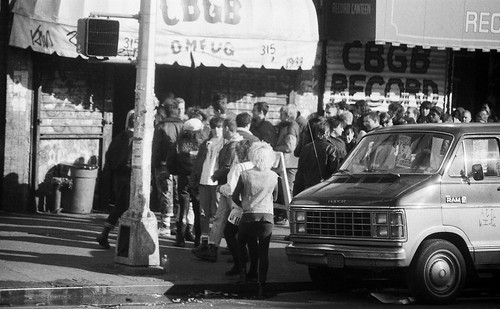
Many of the band's early shows took place at the house-party pad of Steve McAllister, located on 21st South and Redwood Road. Bands like the MGs, The Boards, Atheist, Plants and Angles would play the basement every weekend. That is until a gang of rednecks crashed one of the parties, clashed with a gang of skinheads from Long Beach, and someone ended up getting stabbed. A separate account his it that an out-of-place hippy pissed off a skin from San Francisco and received said stabbing. McAllister would later relocate to NYC to become the sound guy at CBGBs.
The Massacre Guys released two cassettes between 1980-81, Bloody Baggage and Bad Medicine. The latter was recorded by Steve McAllister who would later become the sound man at CBGB. Paul Maritsas left the band shortly after these recordings for college, and eventually founded the Speedway Cafe. Jimmy Germ left the band around this time as well. The Guys enlisted close-friend Karl Alvarez to fill Paul's spot, along with Paul Krowas on 2nd guitar and Phil Miller of local reggae/ska act 004 on saxophone.
In 1982, the band recorded "twenty more songs in a hippy's cedar-paneled basement on the east bench of Salt Lake County." Toxic Shock Records released six of these as the Behind the Eight Ball EP. Tours alongside legendary acts such as The Dead Kennedys, JFA, TSOL, Bad Religion and The Faction followed. In 1984, the MGs entered the studio again to record the Rider EP for Unclean Records (which included an early version of the song "Schizophrenia" that would later appear on the Descendents' 1987 album, ALL).
How would that song end up on a Descendents record? We're getting there.
In 1985 the MGs began to dissolve. Paul Krowas moved to Kansas and Stephen to Virginia. The remaining members enlisted other local artists for a handful of shows over the next year, but it simply was not the same. Stephen returned to SLC for a final farewell show with none-other-than Black Flag at the Salt Lake Community Center, after which the band went on an "indefinite hiatus."
Karl Alvarez sang for Bad Yodelers for awhile before relocating to Southern California to join Stephen Eggerton in legendary melodic punk band the Descendents (there you go). Alvarez has also played with Gogol Bordello, The Last, Underminer, The Vultures, and The Real McKenzies. He recently joined the reunited Lemonheads. Eggerton runs Armstrong Recording Company in Tulsa, Oklahoma.
Jon Shuman went on to play with the Boxcar Kids, Wonder Crash, A.U. (with brother Jamie), the Qualitones, Dollymops and PCP Berzerker. He is currently working on a rock musical. Guitarist Paul Krowas now plays with Kansas City's The Throttlers. As we mentioned, Maritsas went on to form the Speedway Cafe and also played in the band Angle. Various members of Massacre Guys can be found playing MG songs around Salt Lake City to this day in the band Die Shuman Bruder.
The Massacre Guys reunited in the summer of 2009 for a benefit show. Videos from the reunion can be found on YouTube.
The Boards were Salt Lake's first "punk rock" band. Formed in 1978 (a year after D.C.'s Mind Power became the Bad Brains and L.A.'s Panic became Black Flag), The Boards' sound combined the hooks of '60s garage rock with the grit of '70s proto-punk.
Despite numerous line-up changes and a penchant for getting drunk and stealing hot rod engines, the band played shows locally and nationally until 1984.
Basement recordings of The Boards survived in the trunk of singer Monroe's car for 25 years.
In 2003, Soundco Records released these tracks as a full-length titled, "Too Loud for the Silver Cloud." You can hear "I'm a Wreck" and "What the Fuck" at the band's MySpace Tribute Page.
The Boards' guitarist and bassist, brothers Steve and Denny Morrison, currently play in the bluesy rock band, The New Evils.
Below is an 8mm clip of The Boards playing The Roxy circa '80.
Interview with singer Mark Starr at Double Cross Webzine: Part I, Part II.
"To always walk proud and STAY DRUG FREE!"
Insight was Salt Lake's first straightedge hardcore band. Their passionate lyrics on clean living and animal rights set the stage for Salt Lake's infamously outspoken hardcore scene.
Insight formed in 1988 and just a year later signed with Arizona-based SoulForce Records to release the Standing Strong7". Shortly after their signing was announced, the band headlined the "Salt Lake Youth Pride Show" at The Word, featuring Bad Yodelers, Better Way, Head Strong, Right Side Up, and Starving Artists. To support the record, they set out on their first east coast tour alongside California's Chain of Strength. The two teamed up with Judge and Gorilla Biscuits for a number of dates as well.
Standing Strong's New York crossover sound and drug-free convictions placed Insight comfortably on bills across the country with contemporaries from Youth of Today to Insted. The Youth Crew scene embraced Insight and in 1990, Victory Records re-released Standing Strong with the new title What Will It Take and the now-iconic, caged tiger cover art.
Insight tracks also appeared on Victory's Only the Strong and Victory Singles: Volume 1 compilations as well as the classic Voice of Thousands comp which featured early material from Integrity and Outspoken. The band went its separate ways at the turn of the decade.
During Insight's existence guitarist Jeremy Chatelain and bassist Doug Wright also played in the band Brainstorm with Gentry of Better Way. Various members also played in fellow late-80s Salt Lake straight edge band Head Strong (if you know which ones, fill us in!).
Wright went on to Salt Lake's Iceburn and Makeshift. He now plays with up-and-coming, New York City rock band The Dirty Pearls. Guitarist Jeremy Chatelain went on to play with Lumberjack, Iceburn, Handsome (alongside Tom Capone of Bold & Quicksand), Jets to Brazil (alongside Blake of Jawbreaker) and Helmet. He is currently doing a country-pop project called Cub Country. Drummer Chad "Chubba" Smith went also moved on to Iceburn. Singer Mark Starr moved to Seattle after the band's demise and released 3 records with his next project, The Gimmicks. He then head south to L.A. where he played with The Masons and Sweet Evil.